Executive summary
- The S&P Global Eurozone Construction PMI was 43.4 in September (August: 43.0). France was at 39.8, Germany 43.5 and Italy 46.7. Housebuilding fell at its fastest rate since February 2025.
- The eurozone manufacturing PMI rose to 52.9, its highest in 52 months, and the output index reached 53.6.
- EUROFER expects output in steel-using sectors to grow 1.5% in 2026, helped by construction and mechanical engineering, while automotive output falls a further 0.9%. It forecasts apparent steel consumption growth of only 0.1%.
- German factory orders fell 10.6% month on month in August. Excluding large orders, the fall was only 0.1% (Destatis).
Key numbers
43.4 Eurozone construction PMI, Sept (Aug 43.0; 50 = no change) FactS&P Global via ConstructUK
52.9 Eurozone manufacturing PMI, Sept (52-month high) FactHCOB/S&P Global, via trade.gov.tr
−10.6% German real manufacturing orders, Aug, m/m (−0.1% ex large orders) FactDestatis
€725/t Italian rebar ex-works, week to 9 Oct (flat) FactSMM
Fact = checked against the cited source · Calc. = Loharo calculation from cited figures · Uncertain = reported but not confirmed. Unlabelled statements in the text are sourced facts; analysis and uncertainty are labelled inline.
What happened
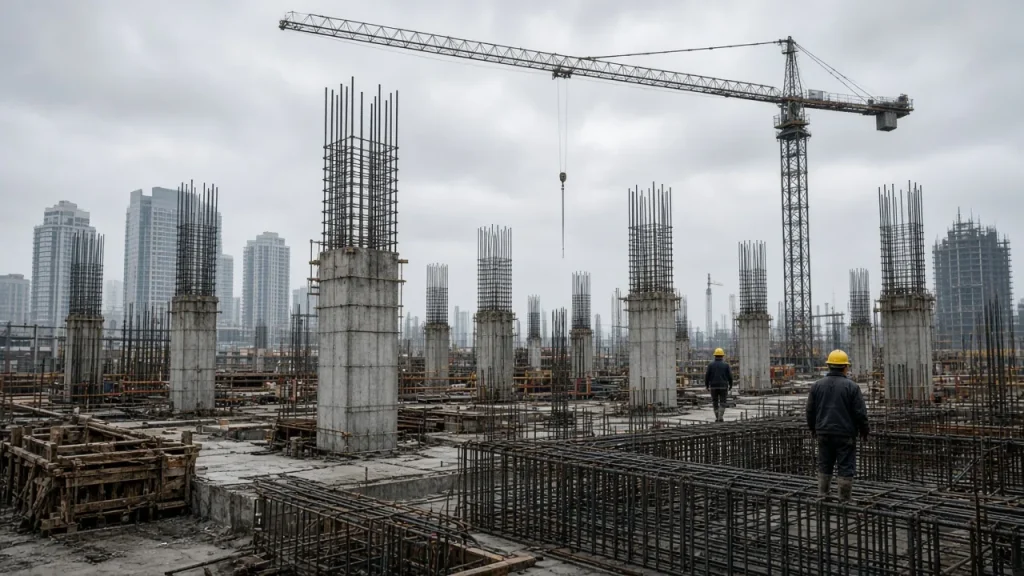
Recent survey data show European steel demand moving in two directions. In construction, S&P Global’s Eurozone Construction PMI, published on 6 October, was 43.4 in September, barely changed from 43.0 in August. That marks another sharp contraction and keeps the index below its long-run average of 47.1. France (39.8) contracted fastest, Germany (43.5) contracted more steeply than in August, and Italy (46.7) declined least. Housebuilding fell at its fastest rate since February 2025, led by Germany. New orders have now fallen for four and a half years. Input price inflation picked up for the first time since April, which S&P links to the cost shock from the Middle East conflict. The 12-month outlook was the weakest since April.
Construction is contracting across the eurozone
S&P Global construction PMI, September 2026 (50 = no change)
Manufacturing looks better. According to S&P Global data summarised by Türkiye’s Ministry of Trade, the HCOB Eurozone Manufacturing PMI rose to 52.9 in September, a 52-month high, and the output index reached 53.6. Order data are volatile, though. Destatis reported that German real manufacturing orders fell 10.6% in August, because orders for other transport equipment (aircraft, ships, trains and military vehicles) dropped 61.5% after an exceptional July. Excluding large orders, the fall was only 0.1%, and orders in the three months June–August were up 1.3% on the preceding three-month period.
EUROFER’s quarterly outlook of 1 October brings these trends together. It expects output in steel-using sectors to grow 1.5% in 2026 after two years of decline, supported by construction and mechanical engineering, while automotive output falls a further 0.9%. Even so, it forecasts apparent steel consumption growth of only 0.1% in 2026, with a ‘more meaningful’ 2.3% rise in 2027. That is a clear downgrade from worldsteel’s April Short Range Outlook, which forecast EU+UK demand growth of 1.3% in 2026 and 3.0% in 2027, driven by infrastructure and defence spending, and which flagged energy prices as the main downside risk.
Why it matters commercially
- Long products face the weakest demand. Rebar, mesh, merchant bars and light sections depend on housing and commercial building, which are the weakest segments. SMM reported Italian rebar flat at €725/t ex-works and wire rod down €15 to €715/t in the week to 9 October. Analysiswith demand this weak, rising scrap and energy costs will squeeze EAF long-product margins rather than reach buyers in full. Merchants can negotiate, but should watch for mill output cuts that tighten supply.
- Flat products have better demand, but it is not broad. Machinery, defence and some infrastructure work support plate and hot-rolled coil, but automotive remains a drag on cold-rolled and coated products. Buyers of plate and structural flats for defence and energy projects face firmer conditions than buyers of automotive grades.
- Construction cost inflation could delay projects. Higher input prices combined with falling orders often lead to delayed or re-tendered projects. Contractors should expect requests to re-index steel in contracts priced before the summer.
- Germany is the swing market. Germany’s housing slump is getting worse even as its industrial survey data improve. Distributors in Germany should keep long-product stocks lean while staying ready for demand from plate and engineering steel users.
Who is affected
Long-product buyers and merchantsRoom to negotiate Rebar and wire rod demand is weakest, but watch for mill output cuts.
EAF long-product producersMargin squeeze Rising scrap and energy costs are unlikely to reach buyers in full.
Plate and structural buyers (defence, energy)Firmer market Machinery, defence and infrastructure support plate and HRC demand.
ContractorsRe-indexing Expect requests to re-index steel in contracts priced before the summer.
Stay ahead of the steel market.
Get our weekly briefing on global steel supply, trade policy, tariffs and market developments—with analysis of what matters to your business.
Free weekly briefing. Unsubscribe anytime. We measure opens and clicks to improve the briefing. See our Privacy Policy.
What to watch next
- Early November: October manufacturing and construction PMIs. A construction reading above 45 would be the first real sign of stabilisation.
- Mid to late October: Eurostat’s August construction output data and Destatis’s August production figures.
- October: worldsteel’s autumn Short Range Outlook (if released on the usual timetable). Compare its EU forecast with EUROFER’s 0.1%.
- Ongoing: European gas prices, which EUROFER says peaked near €80/MWh. These are the main cost risk for construction materials and for EAF producers.
Verification status: Partially verified
- PMI values come from S&P Global’s release as republished by ConstructUK and from a government summary of the HCOB manufacturing release. Destatis and EUROFER figures were checked at source. Price points are attributed to SMM. The commercial points are Loharo analysis.
- Key: Verified = every factual claim checked against a primary source; Partially verified = core facts confirmed, some figures from secondary/market sources; Analysis = interpretation; Developing = story still moving.
Sources
Primary sources
- New orders in manufacturing in August 2026: -10.6% on the previous month — Destatis (German Federal Statistical Office), 6 October 2026
- Economic and Steel Market Outlook 2026-2027: EU steel exports fall 20% as demand outlook remains flat — EUROFER, 1 October 2026
- worldsteel Short Range Outlook April 2026 — World Steel Association (worldsteel), 14 April 2026
Supporting sources
- S&P Global Eurozone Construction PMI: Activity continues to contract markedly in September — S&P Global (republished by ConstructUK), 6 October 2026
- Eurozone Manufacturing PMI Index increased to 52.9 in September 2026 — Republic of Türkiye Ministry of Trade (summarising S&P Global/HCOB), 2 October 2026
- SMM Europe Weekly Review: North-South HRC spread narrows to 3 EUR; imports squeezed by quotas and anti-dumping rules — Shanghai Metals Market (SMM), 9 October 2026
Information as of 11 October 2026. Prices quoted from third-party assessments are attributed to the publisher that reported them; Loharo does not publish its own price assessments. This article is market intelligence, not investment or legal advice.